
Daily Tarot Reading: A Beginner's Guide

Daily Tarot Reading: A Beginner's Guide
Looking to start a daily tarot practice? Here's what you need to know in a nutshell:
- What is it? A daily tarot reading is a simple ritual where you draw one or more cards to set an intention or gain insight for your day. It’s about connecting with your intuition.
- How to begin: Choose a tarot deck that resonates with you. Many beginners start with the Rider-Waite-Smith deck due to its detailed imagery.
- Steps to follow:
- Create a calm, distraction-free space.
- Ask an open-ended question like, “What energy should I focus on today?”
- Shuffle, draw a card, and reflect on its imagery and meaning.
- Why it’s helpful: This practice enhances self-awareness, encourages reflection, and helps you align your actions with your inner guidance.
- Journaling tip: Keep a record of your daily cards to spot patterns and deepen your understanding.
Start small with a one-card draw each morning or evening. It’s a quick, meaningful way to connect with yourself and approach your day with clarity.
Choosing Your First Tarot Deck
Decks for Beginners
The Rider-Waite-Smith (RWS) deck is often seen as the go-to choice for those starting their tarot journey. Brigit Esselmont, Founder of Biddy Tarot, highlights its importance:
"The Rider-Waite is what most Tarot books, decks, and systems are based from, so it's hands down the best deck for beginners."
Originally published in 1909, the RWS deck is known for its detailed imagery across all 78 cards, making it easier to engage in visual and intuitive storytelling.
If the classic RWS design feels a bit outdated, you might explore alternatives like the Radiant Rider-Waite, which features brighter colors, the Modern Witch Tarot for a more current vibe, or the Everyday Tarot mini-deck for a portable option. Once you've picked a deck, the next step is understanding how to choose one that resonates with your intuition.
What to Look for When Choosing a Deck
The most important factor is your visual connection to the deck. Frances Naude, Tarot Reader and Creator of Four Noble Tarot, emphasizes:
"Go for the one you feel the most drawn towards. Do you like it? Does it make you feel supported and nourished?"
It's best to opt for decks with rich, detailed illustrations rather than abstract designs. As Biddy Tarot explains, "Reading the images of the cards helps you activate your intuition and better understand the meanings – so the more imagery, the better!"
Also, check that the deck comes with a comprehensive guidebook to help you learn card meanings and spreads. Pay attention to the physical size of the cards; smaller decks might be more comfortable to shuffle if you have smaller hands. Finally, sticking with a deck based on the RWS system ensures compatibility with most learning materials.
Preparing Your Daily Tarot Practice
Setting Up a Quiet Space
Choose a spot in your home that feels right - a cozy corner, a favorite chair, or a spot on the sofa. The key is to pick a space that signals it's time to focus and connect. Make it comfortable with grounding touches like a soft blanket, good back support, and your feet resting firmly on the floor.
To create a calming atmosphere, light a candle or burn some incense. A tarot cloth can be a nice addition - it protects your cards and helps define this as your sacred space. Maggie Glennon, M.Ed. from Knomii, emphasizes the importance of engaging your senses:
"Tapping into as many senses as possible will help bring you into the present moment and connect with yourself and the cards!"
Soft lighting works better than harsh overhead lights, and cracking open a window for fresh air can help clear your mind. Once your space feels right, stick to a consistent setup to make your practice feel natural and grounding.
Building a Daily Routine
Set aside 10–20 minutes each day for your tarot practice. Mornings are great for setting intentions, while evenings can be used to reflect on your day. Grace Duong, Founder of Mystic Mondays, describes it perfectly:
"Think of it as a daily appointment with your higher self that you can't miss!"
Before pulling a card, try the "Three-Breath" technique: take a deep breath to pause, another to relax, and a third to tune into your intuition. This simple ritual helps shift your mind into a more focused and receptive state. It’s not just about the card you draw - it’s about the act of centering yourself and accessing your inner wisdom.
Stick to a regular schedule to reinforce the intention behind your practice. And to stay fully present, keep distractions like your phone out of reach.
How to Perform a Daily Tarot Reading
Asking Your Question
Begin by shaping your question to invite deeper insights rather than a simple yes or no answer. Phrasing like "What do I need to know today?" or "How can I show up as my best self today?" works well. Robin Dixon emphasizes, "When the question is clear, the cards will be too." For example, instead of asking "Will I pass the exam?", consider "What will the exam be like?" or "How can I best prepare for today's challenges?"
Brigit Esselmont, the Founder of Biddy Tarot, explains, "By asking this question [What do I need to know today?], you'll be able to tap into what your intuition is trying to tell you as you go about your day." If you're feeling uneasy or out of sync, you can tailor your question to address those emotions. For instance, "How can I view the world through the eyes of love today?" can help reframe your perspective.
Once your question feels clear and focused, you’re ready to shuffle and select your card.
Shuffling and Drawing Your Card
Keep your question in mind as you shuffle the deck. Shuffle until you feel that intuitive nudge to stop. Some people also like to cut the deck to the left and restack the cards before drawing.
When you’re ready, either draw the top card or spread the deck out in a fan. Let your hand hover over the cards and pay attention to any sensations - heat, tingling, heaviness, or even a sense of "stickiness." When you feel drawn to a specific card, trust that instinct. To avoid accidental reversals, flip the card sideways when revealing it.
Reading and Understanding the Card
Take a moment to absorb the card you’ve drawn. Notice its colors, symbols, and the immediate feelings it stirs in you - those first impressions can be powerful.
Then, reflect on any key words or themes that resonate with your current situation. Joan Bunning suggests, "The purpose is to heighten your awareness of one approach to life for a single twenty-four-hour period." Use the card’s message to inspire a meaningful action for your day. Speaking your interpretation out loud can offer clarity and help solidify its meaning. Try summarizing your reading into one or two sentences and decide on a specific action to take based on the card’s guidance. Keeping the card visible during the day can serve as a gentle reminder of its message.
Finally, jot down your insights to reflect on how the card’s guidance shapes your day.
Journaling Your Daily Readings
Why Journaling Helps
Keeping a journal of your tarot readings offers a great way to track your growth over time. By documenting each card, you may start to notice patterns - like The Tower showing up whenever you're avoiding a tough conversation, or the Three of Cups appearing when it's time to reconnect with friends. These recurring cards often point to important lessons.
Giulia Mazzola, a life coach, puts it this way:
"To me, journaling with the Tarot is an exercise in self-trust."
Each entry you make strengthens your connection to your inner wisdom.
Journaling also helps refine your interpretations. When you revisit past entries, you can compare your initial reactions to how events actually played out. This habit sharpens your decision-making and helps you make sense of complex situations.
To get the most out of this practice, stick to the routine: draw your card, jot down your first impressions, and reflect later on how the reading aligned with your day. Over time, your journal becomes a valuable tool, revealing patterns and offering insights tailored to your journey.
Using Orbli for Personalized Insights

Orbli takes tarot journaling to the next level by linking your daily card to your natal chart. Instead of relying on general meanings, it provides personalized guidance tailored to your astrological profile. Each reading connects the card to your current transits and life themes, adding depth to your journal entries.
With the Pro plan (starting at $2.60 for the first week, then $6.49/week), you gain daily insights that merge tarot with your birth chart. This integration not only highlights patterns in the cards but also shows how they align with your planetary movements. By combining these layers, Orbli offers a clearer picture of your personal growth, helping you understand why specific cards show up during certain astrological phases.
sbb-itb-7d34b01
How To Start a Daily Tarot Reading Routine
Simple Tarot Spreads for Beginners
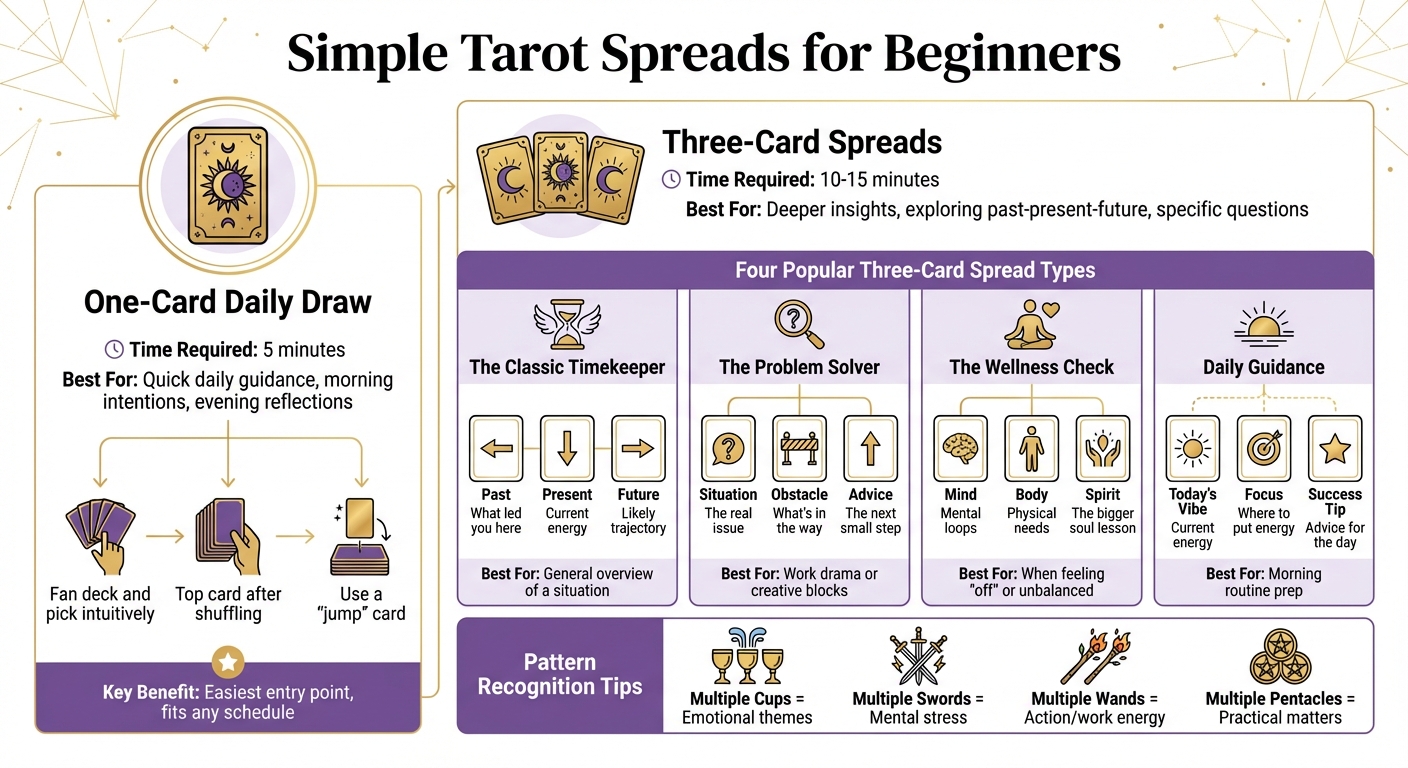
Beginner Tarot Spreads Comparison: One-Card vs Three-Card Readings
One-Card Daily Draw
The one-card spread is the easiest way to dip your toes into tarot reading. With just a single card, you can uncover insight, advice, or a theme to guide you through the next 24 hours. Many people like to do this in the morning to set the tone for their day or in the evening to reflect on lessons they’ve encountered. It’s a quick, five-minute ritual that can easily fit into even the busiest schedule.
How you draw the card is up to you. You could take the top card after shuffling, fan the deck out and pick one intuitively, or even use a card that seems to "jump" out while shuffling. Pay attention to the imagery and your immediate reaction to it - this is how you start building your personal connection with the cards.
Once you’re comfortable with this simple practice, you can move on to multi-card spreads for deeper insights.
Three-Card Spreads
When you’re ready to go beyond single-card readings, three-card spreads are a great next step. They allow you to explore how past, present, and future energies interact or dive into specific questions. Before shuffling, decide what each card position will represent. Here are a few beginner-friendly spreads to try:
| Spread Name | Card 1 | Card 2 | Card 3 | Best For |
|---|---|---|---|---|
| The Classic Timekeeper | Past: What led you here | Present: Current energy | Future: Likely trajectory | General overview of a situation |
| The Problem Solver | Situation: The real issue | Obstacle: What's in the way | Advice: The next small step | Work drama or creative blocks |
| The Wellness Check | Mind: Mental loops | Body: Physical needs | Spirit: The bigger soul lesson | When feeling "off" or unbalanced |
| Daily Guidance | Today's Vibe: Current energy | Focus: Where to put energy | Success Tip: Advice for the day | Morning routine prep |
When interpreting the cards, think of them as pieces of a puzzle that work together to tell a story. Pay attention to recurring patterns. For example, multiple Cups might indicate emotional themes, Swords could point to mental stress, Wands often highlight action or work-related energy, and Pentacles deal with practical matters. If a card’s meaning feels unclear, you can always pull a fourth "clarifier" card for extra context.
Clara Hartwell, a seasoned tarot reader, explains:
"A 3-card spread can name your mood, your fears, your hope, and that quiet ache you've been trying not to look at."
To track your progress, jot down key details of your spreads in a journal. Over time, you might notice "stalker cards" - those that keep appearing in your readings. These cards often point to recurring themes or issues that may need more of your attention.
Conclusion
Starting a daily tarot practice doesn’t require years of study or memorization. What matters most is consistency - setting aside just 10 minutes each morning can help you tap into your intuition and shift how you approach the day. As Grace Duong, Founder of Mystic Mondays, explains:
"Think of it as a daily appointment with your higher self that you can't miss!"
By sticking to this habit, you’ll start noticing recurring patterns in your readings. Over time, these patterns can offer personal insights that guide your growth. This practice isn’t about predicting the future; it’s about grounding yourself, tuning into your inner wisdom, and making choices that align with your goals. Whether you’re navigating work stress, relationship challenges, or simply a packed schedule, pulling a daily card can help you focus on what truly matters.
Your tarot journal becomes a powerful tool - a record of your spiritual evolution that shows the progress you’ve made. As you reflect on your readings, you might also explore tools like Orbli, which combines daily tarot insights with your natal chart. This blend of tarot and astrology offers a deeper look into patterns and growth opportunities that might otherwise go unnoticed.
To get started, try this: tomorrow morning, draw a single card. Jot down your immediate thoughts - don’t overanalyze. Then, observe how that card’s energy plays out during your day. It’s a simple yet impactful way to connect with yourself and set the tone for what’s ahead.
FAQs
How can I pick the best tarot deck as a beginner?
Choosing your first tarot deck is all about finding one that feels right and helps you grow as you learn. A good place to start is with a deck rooted in traditional designs, like the Rider-Waite Tarot. This deck is popular for its straightforward symbolism, making it easier for beginners to understand and interpret.
Pay attention to the artwork, too. The images should speak to you on a personal level - something about the style or theme should feel meaningful and spark your intuition.
Another factor to think about is the size of the deck. Smaller decks can be easier to shuffle and manage, especially if you’re new to handling tarot cards. Lastly, take a look at the guidebook that comes with the deck. A clear, beginner-friendly guide can make a big difference in helping you understand the cards and their meanings.
In the end, trust your gut - go with a deck that draws you in and makes you excited to learn.
What should I do if I don’t understand the tarot card I pulled?
If you're feeling uncertain about the meaning of a tarot card you've drawn, start by leaning into your intuition. Take a moment to really study the card - pay attention to the imagery, colors, symbols, and the emotions it stirs in you. Often, your first reaction can offer insights that connect directly to your situation.
Still feeling stuck? Try journaling. Write down your thoughts, feelings, and any connections you see between the card and your life right now. You can also turn to a tarot guidebook for a deeper dive into the card's traditional meanings. Just remember, these interpretations aren't set in stone - shape them to fit your personal experiences. Over time, as you practice, you'll find your understanding of the cards - and trust in your own intuition - growing stronger.
How does journaling improve my daily tarot readings?
Journaling can add a whole new layer to your daily tarot practice, helping you connect with the cards on a deeper level and sharpen your intuition. By jotting down your thoughts, emotions, and interpretations after each reading, you can start to notice patterns, recurring themes, and even track your personal growth over time. This simple habit can make your readings feel more meaningful and give you fresh insights.
A tarot journal becomes a personal roadmap of your journey with the cards. It helps you dive into the messages they hold while encouraging self-reflection and emotional awareness. Over time, this process transforms tarot into more than just a reading - it becomes a tool for learning about yourself. Plus, as you keep up with this practice, you'll likely feel more confident and find that your readings flow more naturally and with greater purpose.