
How to Read Your Birth Chart for Beginners
How to Read Your Birth Chart for Beginners
Your birth chart is a map of the sky at the exact moment and place you were born. It reveals insights about your personality, emotions, relationships, and life path. To get started, you'll need three key details: your birth date, exact birth time, and birth location. These are essential for creating an accurate chart, which is divided into 12 houses representing different life areas and influenced by planetary positions.
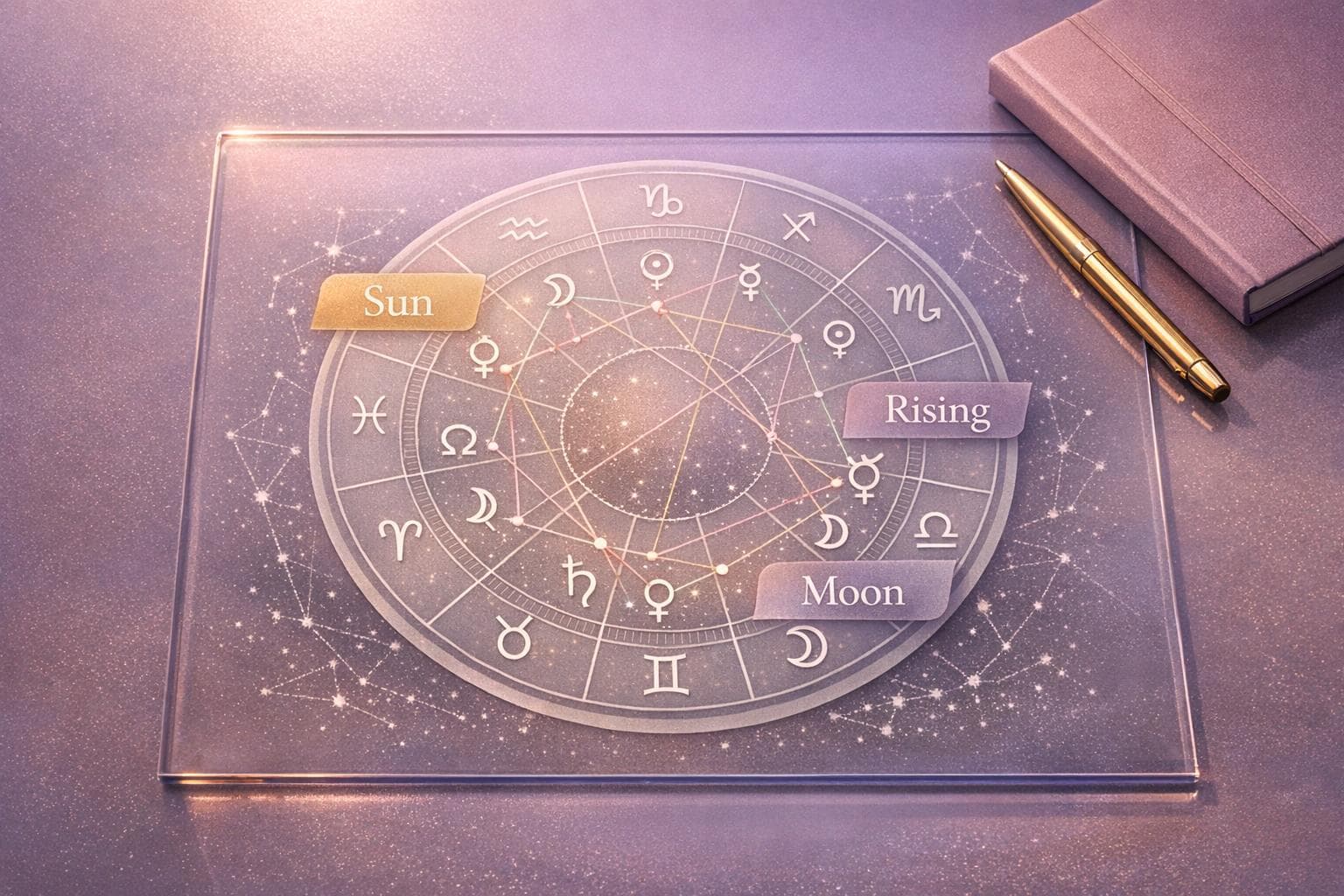
Focus on the "Big Three" signs - Sun, Moon, and Rising:
- Sun Sign: Represents your core identity and purpose.
- Moon Sign: Reflects your emotions and inner world.
- Rising Sign: Shapes how others see you and your outward expression.
Each planet, zodiac sign, and house plays a role, like actors (planets) wearing costumes (zodiac signs) on different stages (houses). Tools like Orbli's free chart generator make it easy for beginners to create and interpret their charts.
Understanding your chart helps you recognize strengths, challenges, and patterns that influence your life. Start with the basics, explore your placements, and use your chart as a guide for self-reflection and growth.
Astrology for Beginners: How to Read a Birth Chart 🌝
sbb-itb-7d34b01
What Is a Birth Chart and Why It Matters
A birth chart, also known as a natal chart, is like a cosmic snapshot of the Sun, Moon, and planets at the exact moment you were born, captured from your specific location on Earth. It’s displayed as a 360° circle divided into 12 sections, with each slice representing a zodiac sign and a distinct area of your life. Think of it as a map that reveals your natural strengths, emotional habits, and the areas where you might face challenges or find opportunities to grow.
"Your birth chart isn't a script - it's a blueprint. You still have free will, but your chart gives you a language to understand your desires, talents, and challenges." – Maria Hayes, Astrologer
The details matter. Your birth date determines the zodiac positions of the planets, your location sets the horizon line (separating visible planets from those below the horizon), and the exact time locks in your Rising sign, which changes roughly every two hours.
The Basics of a Birth Chart
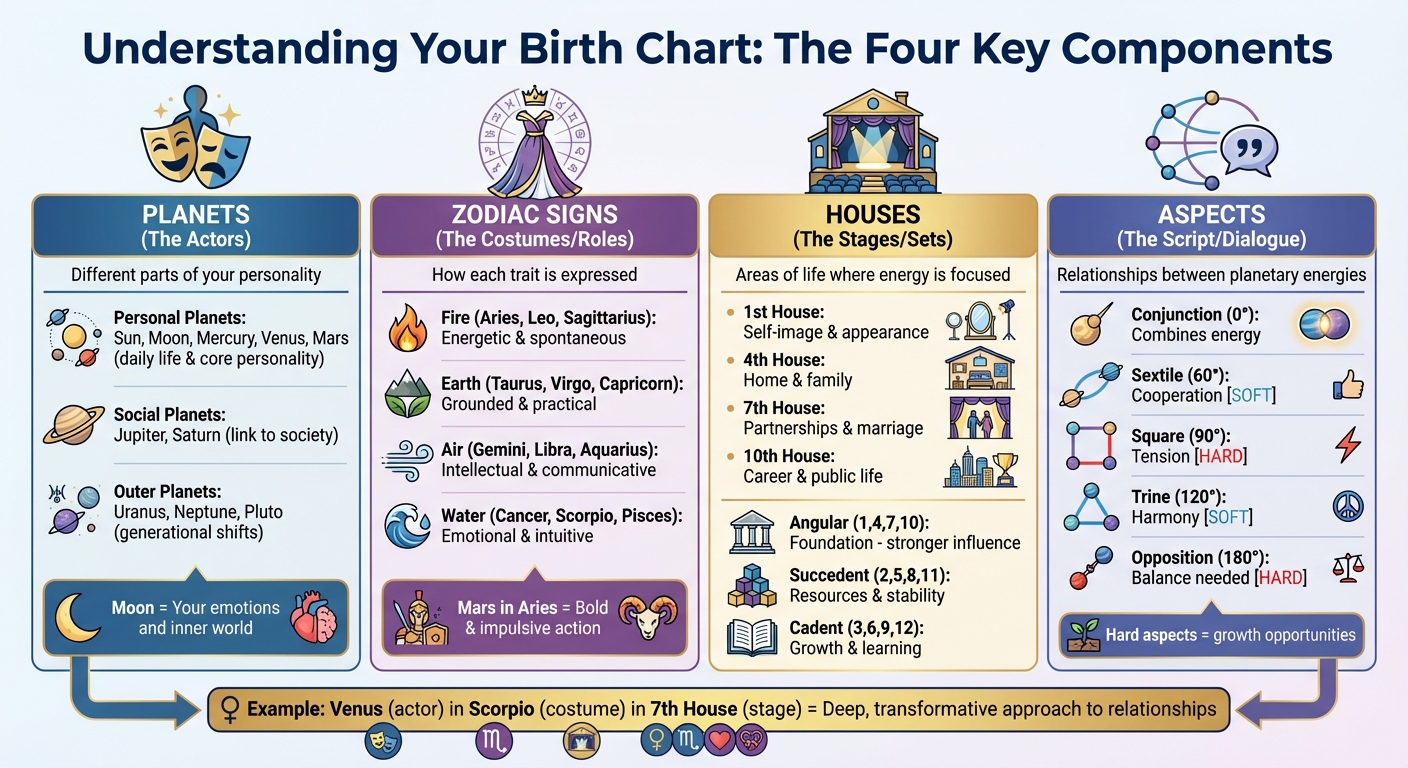
Picture your birth chart as a theatrical production. The planets are the actors, each representing a different part of your personality - your emotions (Moon), how you communicate (Mercury), or what drives you (Mars). The zodiac signs are their costumes, shaping how those traits are expressed. The 12 houses are the stages where the action unfolds, such as career, relationships, or home life. Finally, the aspects are like the script, describing how the planets interact and influence each other.
| Component | Role | Represents |
|---|---|---|
| Planets | Actors | Different parts of your personality |
| Zodiac Signs | Costumes/Roles | How each trait is expressed |
| Houses | Stages/Sets | Areas of life where energy is focused |
| Aspects | Script/Dialogue | Relationships between planetary energies |
These elements combine to create a unique story. For instance, if Venus (the planet of love) is in Aries, known for its bold and impulsive nature, and it’s located in your 7th house (partnerships), you might approach relationships with enthusiasm and a direct attitude.
This structure highlights why having accurate birth data is so important.
Why Accurate Birth Data Is Required
Even a slight error in your birth time can shift your Rising sign and throw off your house placements. Since the Rising sign changes approximately every two hours, getting this detail wrong can lead to interpretations that don’t truly align with your experiences or how you engage with the world.
If your birth certificate doesn’t include a time, try asking family members or contacting the Office of Vital Records in the state where you were born. If you can’t find the information, astrologers often use 12:00 noon as a placeholder. While this can help identify the zodiac signs of your planets, it won’t provide an accurate Rising sign or house placements.
"Without the exact time, your birth chart won't have an accurate rising sign or house configuration." – The AstroTwins
Generating Your Birth Chart with Orbli
Orbli's free birth chart generator maps out your planetary positions to give insights into your personality and life journey. It automatically identifies your Big Three placements: your Sun sign (core identity), Moon sign (emotional tendencies), and Rising sign (how others perceive you). It also breaks down the twelve houses, each representing different aspects of life, like career and relationships. This ensures your chart is accurate and builds on the foundational details mentioned earlier.
How to Use Orbli's Free Chart Generator
Here’s how you can create your birth chart using Orbli’s straightforward tool.
Start by entering your full birth date, exact time, and location. These details are crucial because they allow the tool to pinpoint the exact positions of celestial bodies at the moment you were born.
"Your birth chart is calculated from the stars at your exact birth moment. For the most accuracy, you need your birth date, time, and location - without it, key planetary details may shift." – Astrology.com
Once your chart is generated, Orbli also provides personalized astrology reports and beginner-friendly tools to help you dive deeper into your results.
Orbli's Tools for Beginners
Orbli offers a variety of tools designed to simplify astrology for newcomers. These include the Sun Sign Calculator, Moon Sign Calculator, Ascendant Calculator, Love Compatibility tool, and a Life Path Number calculator. Each one focuses on a specific part of your chart, helping you understand how different planetary influences shape your daily life. These interactive features make it easy to recognize patterns and explore astrology without needing years of study.
Your Big Three: Sun, Moon, and Rising Signs
Once you have your birth chart, it's time to focus on the three placements that define the essence of who you are.
Your Sun, Moon, and Rising signs, often called the "Big Three" in astrology, serve as the foundation of your personality. These placements offer unique insights into how you think, feel, and interact with the world. The Sun highlights your core identity, the Moon governs your emotions, and the Rising sign shapes how others perceive you.
Together, these three create a well-rounded picture of your astrological makeup. As The AstroTwins, founders of Astrostyle, put it:
"The Sun sign makes you blue or red or green. The other parts of the chart will tint your Sun sign so that you're periwinkle or maroon or lime".
Understanding how these placements work together can clarify why you might feel one way internally but show something entirely different outwardly. Let’s dive into what each one represents.
Sun Sign: Your Core Identity
Your Sun sign is the centerpiece of your personality. It reflects your core purpose and what drives you. Most people are familiar with their Sun sign since it’s determined by your birth date and remains in the same zodiac sign for about four weeks before moving to the next. It represents your conscious self and central motivations. This is the sign you usually read about in horoscopes, as it captures the essence of who you are at your core.
Moon Sign: Your Emotional Nature
Your Moon sign governs your inner world - your emotions, instincts, and subconscious needs. Unlike the outward-facing Sun sign, the Moon sign is more private and often becomes apparent only to those who know you intimately or during times of emotional intensity. The Moon moves quickly, shifting into a new sign every 2.5 days. This placement reveals how you nurture yourself and process feelings. As The AstroTwins explain:
"Your moon sign regulates your moods... this caring, sensitive and deeply emotional astrological placement guides our private lives".
Rising Sign: Your Public Persona
Your Rising sign, also known as your Ascendant, shapes the way others see you and the first impression you make. Found on the far-left side of your chart (around the 9 o’clock position), it is the most time-sensitive placement, changing every 2 to 3 hours as the Earth rotates. This means even twins born minutes apart can have different Rising signs. Your Rising sign influences not only how you present yourself to the world but also your physical appearance and approach to new experiences.
How Planets, Signs, and Houses Work Together
Birth Chart Components: Planets, Signs, Houses, and Aspects Explained
Your birth chart is like a three-part system where planets show the action, signs give it a style, and houses reveal where in your life this energy plays out.
For example, if Venus represents action, Scorpio adds intensity to it, and the 7th House places this energy in the realm of relationships. This combination might suggest a deep, transformative approach to partnerships. As The AstroTwins put it:
"The planets are the 'actors' in the movie of your life... the zodiac signs determine the roles the actors play, or the costumes they wear... the houses are the 'movie sets' where the scenes of your life take place."
Together, these elements create a dynamic picture, showing how planetary energy shifts depending on the sign and targets specific areas of life through house placements, such as career, relationships, or personal growth.
The Role of Planets in Your Chart
Planets in astrology fall into three main groups based on their influence:
-
Personal planets: These include the Sun, Moon, Mercury, Venus, and Mars. They shape your core personality and daily life experiences. For instance:
- The Sun reflects your identity and core essence.
- The Moon governs your emotions and inner world.
- Mercury shapes how you communicate and think.
- Venus rules your relationships and values.
- Mars drives your energy, ambition, and desires.
- Social planets: Jupiter and Saturn link your personal world to societal structures. Jupiter brings themes of growth, optimism, and opportunity, while Saturn introduces lessons of discipline, responsibility, and boundaries, showing how you engage with the world’s rules.
- Outer planets: Uranus, Neptune, and Pluto operate on a broader, generational level and often point to deeper, unconscious shifts. Uranus inspires change and innovation, Neptune connects to dreams and spirituality, and Pluto represents transformation and renewal, often tied to pivotal life changes.
The 12 Zodiac Signs and Their Characteristics
Zodiac signs act as filters that shape how a planet’s energy expresses itself. These signs are categorized by elements (Fire, Earth, Air, Water) and modalities (Cardinal, Fixed, Mutable), which influence their overall traits.
For instance, Mars in Aries (a fire sign) acts boldly and impulsively, while Mars in Taurus (an earth sign) channels its energy in a more steady, determined way. The sign modifies the style of a planet’s energy without changing its core function. Similarly, Venus in Aries may lead to falling in love quickly and passionately, whereas Venus in Capricorn approaches love with caution and practicality.
Understanding the elements and modalities of the signs provides insight into planetary behavior:
- Fire signs (Aries, Leo, Sagittarius): Energetic and spontaneous.
- Earth signs (Taurus, Virgo, Capricorn): Grounded and practical.
- Air signs (Gemini, Libra, Aquarius): Intellectual and communicative.
- Water signs (Cancer, Scorpio, Pisces): Emotional and intuitive.
The 12 Houses and Life Areas
The houses divide your chart into 12 areas, each representing a different aspect of life. For example:
- The 1st House relates to self-image and physical appearance.
- The 4th House focuses on home and family.
- The 7th House governs partnerships and marriage.
- The 10th House highlights career and public life.
Houses are grouped into three categories:
- Angular houses (1st, 4th, 7th, 10th): These are the foundation of your life, and planets here tend to have a stronger influence.
- Succedent houses (2nd, 5th, 8th, 11th): These deal with resources, values, and stability.
- Cadent houses (3rd, 6th, 9th, 12th): These focus on growth, learning, and transitions.
If a house is empty, it doesn’t mean that part of your life is unimportant. Instead, it suggests less direct planetary energy, leaving room for your own influence. To understand an empty house, look at the zodiac sign on its cusp and its ruling planet for more clues.
This framework of planets, signs, and houses lays the groundwork for diving deeper into aspects and significant placements in your chart.
Aspects and Angles in Your Chart
Now that you understand planets, signs, and houses, it's time to explore how these elements interact. The next layer of your chart involves aspects - the geometric angles between planets - and angles, which mark key areas of life. Aspects can be thought of as the "conversations" planets are having, indicating whether their interactions are smooth or tense [22,24].
Meanwhile, the four angles in your chart - Ascendant, IC, Descendant, and Midheaven - highlight essential themes like identity, home, relationships, and career [6,16]. Together, these aspects and angles uncover the deeper patterns that shape your journey.
Major Aspects Between Planets
Aspects are divided into two categories: soft aspects, which show ease and natural flow, and hard aspects, which bring challenges and opportunities for growth. Soft aspects highlight your strengths and talents, while hard aspects create tension that can push you to evolve. As the AstroTwins explain:
"A person with a lot of hard aspects may have to pay more dues or overcome a bit more adversity to reach their destiny."
The five key aspects to focus on as a beginner are:
- Conjunction (0°): Combines the energy of two planets, intensifying both.
- Sextile (60°): Brings compatibility and cooperation between planets two signs apart.
- Square (90°): Creates tension between planets three signs apart, requiring effort and compromise.
- Trine (120°): Connects planets in the same element, creating harmony and showcasing natural talents.
- Opposition (180°): Pits planets directly across from each other, creating tension that calls for balance [22,23].
When studying your chart, start by looking for aspects with a "tight orb" - angles within 5° of exact. These have a stronger impact. Pay special attention to aspects involving your Sun, Moon, or Rising sign, as these are deeply personal and influential.
While aspects focus on internal dynamics, the chart’s angles reveal the structure of your external life.
The 4 Chart Angles
The four angles mark the starting points of the cardinal houses (1st, 4th, 7th, and 10th), which represent action and major life areas. Here's a breakdown of what each angle signifies:
- Ascendant: Found on the left side of the chart, this angle reflects your outward expression, physical appearance, and how others initially perceive you [5,8,9].
- IC (Imum Coeli): Located at the bottom of the chart, it governs your roots, home life, family traditions, and private world [9,25].
- Descendant: Directly opposite the Ascendant, it reveals your approach to relationships and what you value in partnerships, including marriage [9,25].
- Midheaven: Positioned at the top of the chart, this angle represents your career, public image, and the legacy you aim to create [5,25].
To find these angles on your chart, look for the horizontal line marking the Ascendant on the left and the vertical line at the top for the Midheaven. These key points provide a framework for understanding how your internal dynamics (aspects) connect with your external life (angles).
How to Focus on Your Most Important Placements
Once you’ve explored the basics of your chart, it’s time to dig deeper and identify the placements that hold the most influence over your personality and life path. By honing in on your strongest placements and recurring patterns, you can uncover your core strengths, challenges, and guiding direction.
Find Your Strongest Planets and Placements
Start by pinpointing planets in positions of strength using astrology calculators. A planet's strength depends on how easily it can express its energy in a particular sign. Two key conditions to look for are Domicile (when a planet is in the sign it naturally rules) and Exaltation (when a planet operates at its peak potential).
For example:
- If your Venus is in Taurus, it’s in Domicile, making it easy for you to express love, beauty, and values.
- If your Mars is in Capricorn, it’s in Exaltation, giving you a natural ability to act with discipline and strategy.
Next, identify your Chart Ruler, which is the planet that rules your Rising sign. This planet plays a pivotal role in your chart, revealing your primary life focus. For instance, if you’re a Scorpio Rising, Mars (or Pluto in modern astrology) is your Chart Ruler, and its house placement will show where your energy is most intensely directed.
Pay special attention to angular placements, which are planets located in the 1st, 4th, 7th, or 10th houses (the Cardinal houses). These positions amplify a planet’s influence, making its energy more visible and impactful. For instance, a Sun in the 10th house often signifies a strong drive toward career success and public recognition.
To confirm these strengths, consult a Table of Dignities to see if your planets hold any of these powerful positions.
Look for Patterns and Themes
After identifying your strongest placements, shift your focus to uncovering broader patterns in your chart. Start by examining hemisphere distribution - the placement of planets above or below the horizon. If most of your planets are above the horizon, your life may center on public roles, career, and external achievements. If they’re below the horizon, your focus might lean more toward personal growth, home life, and privacy.
Next, evaluate the balance of elements and modalities:
- A strong presence of Fire signs (Aries, Leo, Sagittarius) suggests a bold, action-driven nature.
- A lack of Air signs (Gemini, Libra, Aquarius) might point to challenges with communication or objectivity.
- If your planets are concentrated in Cardinal signs (Aries, Cancer, Libra, Capricorn), you’re likely someone who thrives on initiating new ventures.
Consider the aspect patterns in your chart as well. Clusters of hard aspects (like squares and oppositions) often indicate areas of tension that push you toward growth, while soft aspects (such as trines and sextiles) highlight natural talents and ease. If you're unsure how these aspects interact, you can chat with an AI astrologer for personalized insights. As Astro Basics puts it:
"Challenging aspects aren't 'bad' - they often indicate your greatest sources of strength and achievement."
Lastly, check for stelliums, which occur when three or more planets are grouped in the same house or sign. Stelliums spotlight major life themes:
- A stellium in the 7th house points to a life centered around relationships.
- A stellium in Gemini emphasizes communication, learning, and adaptability.
Conclusion
Your birth chart acts as a guide to understanding your core self and the path your life might take. By diving into the details of your Sun, Moon, and Rising signs, along with planets, houses, and aspects, you gain a meaningful tool for self-reflection and growth. This knowledge allows you to step away from automatic reactions and instead respond with intention. As astrologer Priya Kale explains:
"A natal chart shows seed potential. With self-awareness, one can choose to respond (rather than react) to life - creatively and consciously."
By weaving together the key elements of your chart, you can see it as a starting point rather than a rigid plan. Think of it as your soul's "factory settings", offering insight into your tendencies while leaving plenty of room for free will and personal evolution.
With Orbli's free chart generator and beginner-friendly tools, you can continue this journey of self-discovery. The more you engage with your chart, the more you'll uncover about your unique strengths, challenges, and purpose.
Take the first step today and delve into your chart to gain a clearer, more confident understanding of yourself.
FAQs
Why is knowing your exact birth time important for reading a birth chart?
Knowing your exact birth time is key to creating an accurate birth chart. It determines your rising sign (ascendant) and the placement of the 12 houses, which offer valuable insights into your personality, relationships, career, and overall life direction. Even a small variation in time can change these placements, altering how the chart is interpreted.
If you're unsure of your birth time, start by checking your birth certificate or asking family members for details. The closer you can get to the exact time, the more precise and insightful your astrological reading will be.
What do my Sun, Moon, and Rising signs say about me?
Your Sun, Moon, and Rising signs - often referred to as the Big Three in astrology - provide a deeper understanding of your personality and how you navigate life.
- Sun Sign: This represents your core identity, including your ego, motivations, and the essence of who you are at your very center. Think of it as the foundation of your personality.
- Moon Sign: Your Moon sign reflects your inner emotional world. It reveals how you process feelings, what brings you comfort, and how you respond to life’s ups and downs on a more personal, emotional level.
- Rising Sign (Ascendant): This is the energy you project outward. It influences first impressions and how you approach new experiences or situations, acting as the "face" you show to the world.
By combining these three, you get a fuller picture of both your inner self and the way you interact with others. Exploring them can offer valuable insights into your strengths, emotional needs, and how you connect with the world around you.
What tools does Orbli provide to help me understand my birth chart?
Orbli makes it simple for beginners to dive into astrology with user-friendly tools. The Birth Chart Calculator is completely free and straightforward - just input your birth date, time, and location, and you'll get an instant, personalized natal chart. It highlights essential details like your Sun, Moon, and Rising signs, along with planetary placements, houses, and aspects.
If you're looking for more in-depth guidance, Orbli also offers personalized birth chart readings. These readings provide detailed explanations tailored specifically to your chart, helping you discover insights about your personality, strengths, and life direction. It's a great way to deepen your understanding of astrology while uncovering what makes you, you.