
New to Astrology? Your Essential Starter Checklist
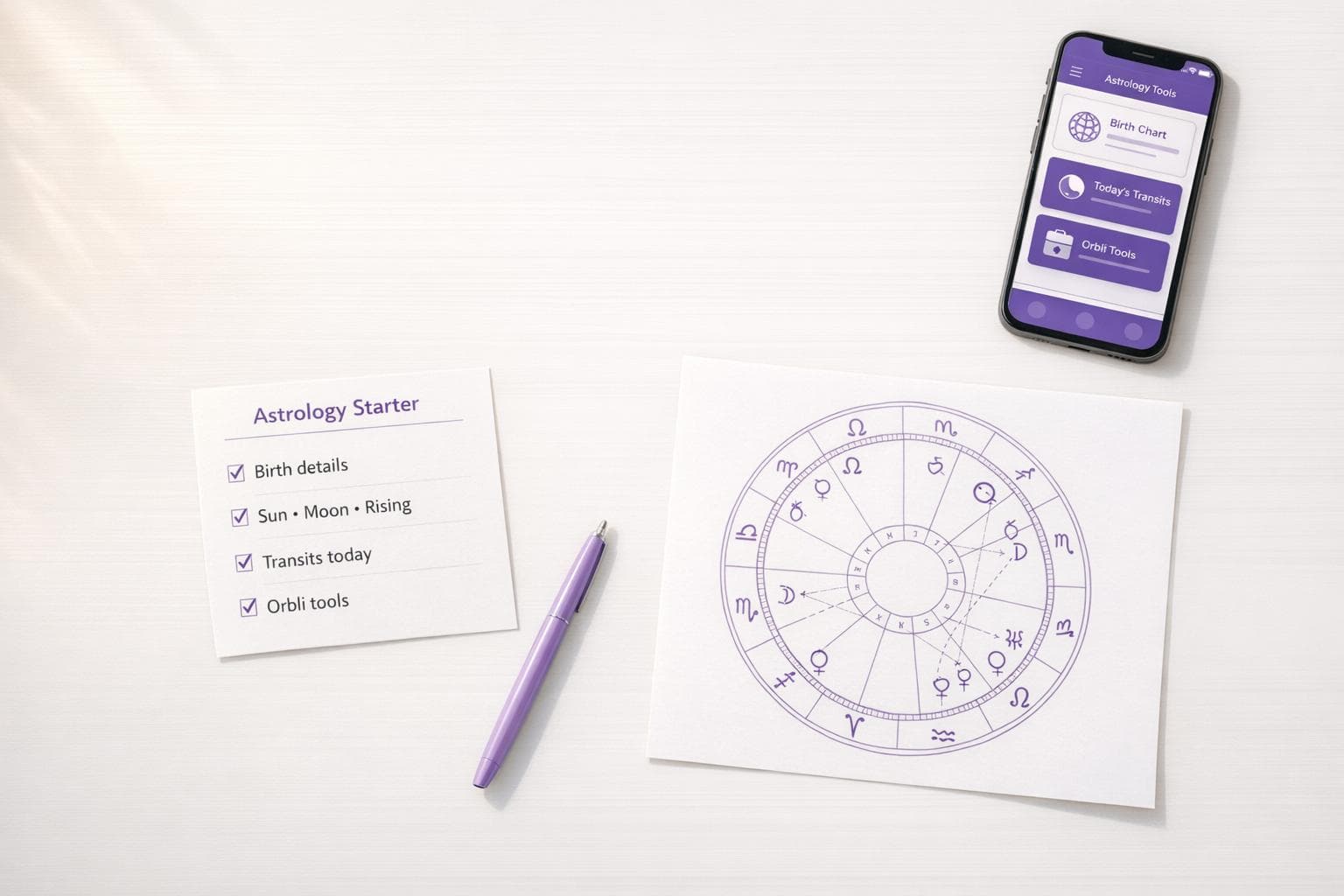
New to Astrology? Your Essential Starter Checklist
Astrology is a tool for self-reflection, helping you connect cosmic movements to your personality, emotions, and life purpose. The first step is understanding your natal chart, which maps the positions of celestial bodies at the moment of your birth. This chart reveals your Sun, Moon, and Rising signs, often called the "Big Three", which form the foundation of your astrological profile.
Here’s a quick guide to get started:
- Gather Your Birth Details: You need your exact birth date, time, and location. A precise birth time is crucial for an accurate chart, especially for your Rising sign.
- Generate Your Birth Chart: Use free astrology calculators to create your chart. It displays planets, zodiac signs, and houses that influence your life.
- Understand Your Big Three:
- Sun Sign: Represents your core personality and life goals.
- Moon Sign: Reflects your emotions and inner world.
- Rising Sign: Shows how you present yourself and interact with the world.
- Dive Deeper: Explore personalized insights, track planetary transits, and read beginner-friendly astrology books to build your knowledge.
- Practice: Analyze natal charts of friends or family to see how placements align with real-life traits.
Astrology isn’t about predicting the future - it’s about understanding yourself better to navigate life with clarity and intention.
Step 1: Collect Your Birth Information
Why You Need Your Exact Birth Date, Time, and Location
To create an accurate birth chart, you'll need three critical details: your date of birth, exact time of birth, and location of birth. Each of these pieces plays a role in mapping your unique astrological profile.
The time of birth is particularly crucial because your Rising sign (or Ascendant) shifts roughly every two hours. This sign sets the framework for the 12 astrological houses, which indicate how planetary influences shape different parts of your life, like career, family, and relationships. As Chelsea Jackson from Astrology.com puts it:
"The Rising sign essentially marks the official beginning of your life here on earth, so the birth time's meaning is by far the most critical aspect of your natal makeup - even more so than your sun sign or your moon sign."
Your Moon sign, which reflects your emotional nature, also relies on precise timing since the Moon moves about 12 degrees each day. Meanwhile, your birth location determines what was rising on the eastern horizon at the exact moment you were born.
How to Find Your Birth Time
The best place to look for your birth time is your full birth certificate, as standard versions often leave out this detail. If the certificate doesn't include it, try contacting the hospital where you were born - they might still have the original records. Other options include checking family records or searching digital archives, such as emails or notes from your birth date.
When asking family members, be mindful of rounded times like "7:30 AM" or "3:00 PM." According to Journeywoman Astrology:
"A rounded figure... may mean whoever recorded the birth time guesstimated, which is not uncommon, whether in a hospital birth or otherwise."
Exact times (e.g., 2:44 AM) are far more dependable. If you can't find the exact time, try to narrow it down to a specific window, like "early morning" or "late evening". If all else fails, you can use a noon chart, set to 12:00 PM. While this method captures most planetary positions, it won't provide a reliable Rising sign or house placements.
Gathering this information is a key first step before generating your birth chart. Accurate details ensure your chart reflects the full scope of your astrological makeup.
sbb-itb-7d34b01
Step 2: Generate Your Free Birth Chart with Orbli

Using Orbli's Birth Chart Calculator
Once you've gathered your birth details, you're ready to use Orbli's birth chart calculator to create your free natal chart. Simply input your birth date, precise time, and location into the calculator. This tool will map the positions of the Sun, Moon, and planets at the exact moment of your birth. As Astrology.com explains:
"Your birth chart is calculated from the stars at your exact birth moment. For the most accuracy, you need your birth date, time, and location - without it, key planetary details may shift."
If you're unsure of your exact birth time, you can use 12:00 noon as a placeholder. Keep in mind, though, that this might affect the accuracy of your Rising sign and house placements.
Once the chart is generated, take a moment to review its structure - it’s essentially your cosmic blueprint.
Reading Your Chart Layout
Now that you have your chart, let’s break down its key components.
Your birth chart appears as a circle divided into 12 sections, or houses, each representing different areas of your life. Around the outer edge, you'll see the zodiac signs, while various symbols (glyphs) within the chart indicate the planets' positions in both signs and houses. Additionally, colored lines connecting these symbols (aspects) show how the planets interact, offering insights into the dynamics of your personality.
Start by locating the 9 o’clock position on the chart. This marks your Rising sign and the start of the 1st house. The houses then progress counter-clockwise. You’ll also notice a horizontal line cutting through the circle; planets above this line relate to your public and external life, while those below reveal more about your private, inner world.
Familiarizing yourself with this layout is essential for the next steps, as it sets the stage for exploring your Sun, Moon, and Rising signs in greater detail.
Astrology for Beginners: Read Your Natal Chart in 30 Minutes
Step 3: Find Your Sun, Moon, and Rising Signs

Sun, Moon, and Rising Signs: The Big Three in Astrology Explained
Now that you’ve got the layout of your chart down, it’s time to zero in on the three placements that astrologers often call the "Big Three": your Sun, Moon, and Rising signs. Together, these placements shape the foundation of who you are - your essence, emotions, and how the world perceives you.
To locate these in your chart, look for specific symbols: the Sun sign is represented by a circle with a dot in the center (☉), the Moon sign is shown as a crescent moon (☽), and your Rising sign (or Ascendant) is typically labeled as "Asc" or "AC" on the far left of the chart wheel. Let’s break down what each of these means and why they matter.
What Your Sun Sign Represents
Your Sun sign is all about your core identity - it’s the driving force behind your personality and how you approach life. This is the part of you that shines through when you’re chasing goals, making decisions, or asserting yourself. The AstroTwins describe it like this:
The Sun sign makes you blue or red or green. The other parts of the chart will tint your Sun sign so that you're periwinkle or maroon or lime.
Most people know their Sun sign because it’s based on the date of birth, and the Sun stays in one zodiac sign for about 30 days. However, if you were born on a day when the Sun was transitioning between signs, you’ll need your exact birth time to figure out which sign the Sun was in at that moment.
What Your Moon Sign Represents
While your Sun sign is about your outer self, your Moon sign delves into your inner world - your emotions, instincts, and what makes you feel secure. It’s the part of you that comes out when you’re relaxed or under pressure. Molly Pennington, Ph.D., explains it beautifully:
The astronomical reality is the moon is always reflecting the sun's light. The sun would be like our self, our identity - and the moon comes along and it reflects that. It holds up a mirror to yourself.
The Moon moves quickly, changing signs every 2.5 days. Because of this, even a slight difference in your birth time can shift your Moon sign.
What Your Rising Sign Represents
Your Rising sign, or Ascendant, is how you present yourself to the world. It influences your outward behavior, physical appearance, and how you handle new situations. The AstroTwins describe it like this:
Your rising sign is a bit like your storefront window. How do you represent to the world? What do you want people to see?
This placement is highly time-sensitive, shifting to a new sign every two hours. That’s why knowing your exact birth time is crucial. Beyond first impressions, your Rising sign also sets the framework for your entire chart by determining the positions of the 12 houses. This is why many astrologers suggest reading horoscopes for your Rising sign rather than your Sun sign.
Here’s a quick overview of the Big Three and what they represent:
| Placement | Symbol | Represents | Manifestation |
|---|---|---|---|
| Sun | ☉ | Core identity, ego | Your basic personality and life goals |
| Moon | ☽ | Emotions, instincts | Your private feelings and inner needs |
| Rising (Asc) | Asc / AC | Public persona | First impressions and outward behavior |
Once you’ve identified your Sun, Moon, and Rising signs, take a moment to see if any of them match. If they do, it amplifies those zodiac traits in your personality. With your Big Three in hand, you’re ready to dive deeper into your chart and uncover even more personalized insights.
Step 4: Get Personalized Insights with Orbli's AI Astrologist
Your Sun, Moon, and Rising signs are just the beginning. Your full birth chart is packed with planetary placements, aspects, and patterns that shape your personality and life path. That’s where Orbli's AI Astrologist steps in. It takes all that intricate astrological data and turns it into clear, actionable insights tailored just for you.
Getting Custom Interpretations of Your Chart
Orbli’s AI dives into the exact positions of the planets, based on your date, time, and location of birth. It uses what’s called the "3-Part Puzzle" to break down the information:
- Planets: Think of these as the "actors", representing different aspects of your personality and experiences.
- Zodiac Signs: These are the "roles" or "costumes", showing how each planet’s energy is expressed.
- Houses: Picture these as the "stage", revealing which areas of your life are influenced.
For example, if Venus is in Scorpio in your 7th house, the AI won’t just give you a generic description of Venus in Scorpio. Instead, it’ll explain what this means for your relationships and partnerships, offering insight into how you connect with others on a deeper level.
The AI doesn’t stop at interpreting your natal chart - it also keeps an eye on the ever-changing planetary movements to give you timely updates.
Using Daily and Weekly Forecasts
Orbli’s AI goes beyond your birth chart by tracking transits, or the current movements of the planets and how they interact with your natal chart. This allows it to deliver daily and weekly forecasts that are completely tailored to you.
For instance, the Moon changes zodiac signs every 2–3 days, and Orbli’s AI monitors these shifts to show how they affect your chart. If Mercury goes retrograde, you won’t just see a generic warning. Instead, you’ll get a detailed explanation of how this retrograde impacts specific areas of your life, based on its movement through your chart.
Astrologer Emmalea Russo sums up the philosophy behind this approach:
The sky is a mirror of life on earth. The movements and positions of the planets and stars can help us understand ourselves and our place in the universe.
The AI also identifies aspects, which are the angles between the current planets and your natal placements. These aspects can reveal whether the energy around you is flowing smoothly or presenting challenges. This means your daily guidance is based on real-time cosmic patterns, not generic predictions, giving you a personalized roadmap for navigating your day.
Step 5: Read Beginner Astrology Books
While Orbli's AI provides quick, personalized interpretations, diving into beginner astrology books helps you understand the "why" behind those insights. Books give you the tools to decode your chart and deepen the knowledge Orbli offers. Think of them as your guide to learning astrology's unique language.
Best Books for Astrology Beginners
A great starting point is "The Only Astrology Book You'll Ever Need" by Joanna Martine Woolfolk. This book has been a trusted resource for years, offering step-by-step guidance on creating and interpreting natal charts. It covers everything from sun, moon, and rising signs to planetary placements. The way it simplifies complex ideas makes it perfect for beginners.
Another excellent choice is "You Were Born for This" by Chani Nicholas. This book focuses on the "big three" (sun, moon, and rising signs) and explains planetary roles in an approachable, friendly tone. Nicholas's writing style makes astrology feel less overwhelming. If you're someone who learns best through practice, "The Only Way to Learn Astrology: Volume 1" by Marion D. March might be your go-to. It includes quizzes and exercises to help you think like an astrologer. With a 4.16 rating on Goodreads from over 300 reviews, it's praised for its clear and structured approach.
How to Learn from Astrology Books
Start with your own chart instead of trying to memorize everything at once. Apply what you've already learned about your Sun, Moon, and Rising signs to see how different authors interpret these placements. If a book feels confusing or discouraging, don't hesitate to move on. As astrologer and herbalist Alexis J. Cunningfolk wisely advises:
My overall guideline is that if you're reading through an astrology book and the interpretations that the author is offering makes you feel bad about yourself, uninspired or confused, pass it on and find something else.
One practical tip is to learn the glyphs - the symbols for planets and signs - early on. Most astrology books and charts use these symbols, and recognizing them will speed up your learning process. Instead of trying to memorize everything, treat books as tools to reference when needed. For instance, if you notice a transit affecting your life, you can turn to a resource like Robert Hand's "Planets in Transit" to get more clarity.
These books provide a strong foundation for your astrology journey. Once you're comfortable, you'll be ready to move on to practicing natal chart readings in the next step.
Step 6: Practice Reading Natal Charts
Now that you’ve got a grasp on the Big Three, it’s time to dive into real natal charts. This hands-on practice will deepen your understanding of astrology and help you see how personality traits play out in real life. Start by analyzing charts of people you know - it’s a fascinating way to connect theory with reality.
Begin with Charts of People You Know
To get started, gather birth details from friends or family members. You’ll need their full date of birth (month, day, year), exact birth time, and the city and country where they were born. If the exact birth time isn’t available, using 12:00 noon as an estimate can still provide insight into planetary placements, though the Rising sign and house positions won’t be precise.
Once you generate a chart, focus on the Sun (core personality), Moon (emotional world), and Rising sign (how they present themselves). Compare these placements with what you know about the person. For instance, does an Aries Sun align with their spontaneous decisions? Or does a Capricorn Moon explain their reserved emotional style? An example of this in action comes from astrologer Tali Edut, who analyzed a chart for an ELLE editorial staff member in 2023/2024. She noted a Moon in Pisces (hinting at a romantic nature) placed in the 6th House (structure and routine), suggesting the individual thrives when they have daily routines that support emotional expression.
Look for Patterns in Charts
After working with a few charts, start looking for recurring patterns. Are most of the planets above the horizon? This might point to someone with a more public or outward focus. Or are they below the horizon, suggesting a more introspective or private nature? You can also examine the balance of elements: for instance, a chart dominated by Fire signs might indicate someone who acts on instinct, while an abundance of Air signs could suggest a more intellectual or communicative approach.
Use the "3-part puzzle" framework mentioned earlier to analyze charts more deeply. Think of the planets as the "actors", the Zodiac signs as their "costumes" (how the energy is expressed), and the houses as the "stage" where the action happens. For example, Mercury (communication) in Aries (bold, impulsive) in the 10th House (career) might describe someone who speaks assertively in professional settings. Pay attention to aspects, too - these are the "conversations" between planets. Conjunctions show fusion, squares highlight tension, and trines reveal harmony.
Tali Edut offers this perspective:
Allow yourself to suspend the idea that there's one right answer and just think of it as a sort of self-inquiry. What fits me, or how do I see this showing up for me? If you're unsure where to start, you can ask an AI astrologer for immediate insights into your specific placements.
Astrology isn’t about predicting a fixed future - it’s about understanding potential. As The AstroTwins explain:
The more you understand how you're wired astrologically, the more free will you gain
Step 7: Track Current Planetary Transits
Now it’s time to explore how current planetary transits interact with your natal chart. While your natal chart provides a static snapshot of your cosmic blueprint, transits bring it to life, offering real-time insights into unfolding patterns and opportunities.
Understanding Transits and Their Effects
A transit happens when a planet’s current position forms a specific angle, or aspect, with a planet or key point in your natal chart. These interactions activate specific themes, bringing certain energies or challenges into focus. As The AstroTwins explain:
A transit chart captures the planets in motion at any given day. You can use a transit chart to "plan it by the planets", or look back and review a particular date in your past.
The speed of a planet determines how long its influence lasts. Inner planets, like the Moon and Mercury, move quickly and affect day-to-day moods and interactions. For instance, the Moon changes signs every 2.5 days, creating swift emotional shifts, while Mercury transits typically peak over 1–2 days.
Outer planets, on the other hand, move much more slowly. Their transits unfold over months or even years, shaping long-term growth and life themes. These slower-moving planets often mark pivotal periods of transformation or restructuring.
Transits reveal trends and activate your potential, but they don’t dictate outcomes. Modern astrology emphasizes how these energies impact your inner world, leaving you free to decide how to respond.
Tracking Transits with Orbli
Orbli makes tracking planetary transits simple and visual. Its dual-ring system places your natal chart in the inner ring and overlays current planetary positions in the outer ring. This setup lets you instantly see which planets are interacting with your natal placements.
You can customize your view to focus on either short-term or long-term influences:
- Outer planets only: Highlight major life themes, like a Saturn transit through your career house signaling professional changes or restructuring.
- Inner planets only: Zero in on daily opportunities, such as a Venus transit for romance or a Mercury transit for clear communication.
For Orbli Pro subscribers, the platform offers daily and weekly forecasts written in plain language. Instead of technical astrology jargon, you’ll get easy-to-understand insights like, "Mars is transiting your 3rd House this week - expect more assertive communication and a desire to tackle short trips or learning projects." The AI astrologist feature can even answer specific questions about how a transit might affect you based on your unique chart.
Timing Matters: Orbs and Retrogrades
The strength of a transit depends on its orb - the degree of closeness between the transiting planet and your natal placement. Transits are most impactful when the orb is tight, usually within 1–3 degrees. For example, if transiting Jupiter is at 15° Gemini and your natal Sun is at 16° Gemini, that conjunction will feel especially powerful.
Retrograde transits, or "triple-hits", add another layer of complexity. These occur when a planet passes over the same point three times: first during direct motion, then retrograde, and finally direct again. Each phase serves a purpose: the first contact raises an issue, the retrograde phase encourages reflection and inner work, and the final pass supports integration and resolution. Orbli’s transit calendar helps you easily identify and prepare for these cycles.
As of February 10, 2026, notable transits include Venus entering Pisces (bringing a focus on compassion in relationships), Mercury in Pisces squaring Lilith in Sagittarius (potentially revealing hidden truths), and the Moon entering Sagittarius (sparking a desire for adventure and big-picture thinking).
Step 8: Consider Upgrading to Orbli Pro
Once you've explored your birth chart and started tracking transits, you might be ready to take things to the next level. Orbli Pro offers a chance to deepen your astrology journey with tailored insights that align with your unique chart and current life situations.
What Orbli Pro Brings to the Table
Orbli Pro goes beyond the basics, offering a personalized approach to astrology. While the free tools provide general interpretations, Pro delivers detailed insights that cater specifically to your life path.
Key features include synastry readings to analyze relationship dynamics, daily insights tailored to your chart, and weekly and monthly forecasts to help you navigate upcoming planetary patterns. There's even a daily tarot reading feature that connects directly to your natal chart, adding a reflective layer to your experience.
Astrologer Ophi describes modern astrology as "your own AI system (astrological intelligence, if you will)", and Orbli Pro embodies this concept by offering a system designed to guide you through life with precision and clarity.
Orbli Pro Pricing and Trial Details
Orbli Pro is available for just $2 for the first week, followed by $4.99 per week. It also comes with a 30-day money-back guarantee, giving you the flexibility to cancel anytime. Even if you stick with the free version, you'll still have access to your birth chart, current life themes, and over 20 calculators. However, upgrading to Pro unlocks a deeper level of personalized guidance, making it easier to integrate astrology into your daily life.
Conclusion
You've taken the first essential steps into the world of astrology. This checklist lays a strong groundwork, and diving deeper will open up even greater understanding. As astrologer Priya Kale insightfully shares:
The study of astrology is vast and seemingly endless; it requires patience, humility, and dedication. You can never stop learning.
Astrology becomes richer with practice. Observing cycles and transits reveals patterns that go beyond what any textbook can teach. The AstroTwins emphasize this point:
The more you understand how you're wired astrologically, the more free will you gain.
By reflecting on past transits and exploring your placements, you'll uncover personal insights that deepen your connection to astrology.
To help you continue this journey, Orbli offers tools designed for every stage of exploration. From free birth charts and calculators to advanced features with Orbli Pro, you'll have resources to support your growth. As Ophi puts it:
Astrology is a hard skill, a spiritual technology, your own AI system (astrological intelligence, if you will), that we all need in these uncertain times.
Revisiting your chart as life unfolds will reveal new layers and insights. Dr. Stormie Grace beautifully captures this process:
Astrology is a practice of grace. A reminder that, like a garden, our lives unfold in their own right timing.
Each discovery invites you to dig deeper into your unique cosmic design. Start where you are, make use of the tools available, and trust the journey ahead. Your cosmic blueprint holds endless possibilities, and Orbli is here to guide you along the way.
FAQs
What if I don’t know my exact birth time?
If you’re unsure of your exact birth time, don’t worry - you can still dive into astrology. While details like your rising sign and house placements might not be entirely accurate, there are ways to estimate. Start by checking your birth certificate, asking family members for any stories or clues, or comparing your personality traits to those associated with different rising signs. You can also use online natal chart calculators, which can provide insights based on just your birth date and location.
Why do my Sun, Moon, and Rising signs feel different from each other?
Your Sun, Moon, and Rising signs each highlight different parts of who you are, which is why they can feel so distinct. The Sun sign represents your core self - your essence and how you express it outwardly. The Moon sign dives into your emotional world, revealing your instincts and inner feelings. Meanwhile, your Rising sign (or Ascendant) shapes the way you appear to others, influencing first impressions and your external persona. Together, these three signs weave a more complete picture of your personality, all based on the stars' alignment at the moment you were born.
Which transits should I track first as a beginner?
As someone just starting out, it's best to focus on the faster-moving planets: the Moon, Mercury, and Venus. The Moon moves through all 12 houses every month, giving you a chance to observe how it influences emotions and day-to-day rhythms. Mercury and Venus, on the other hand, highlight patterns in communication, relationships, and personal values. By concentrating on these planets, you'll uncover clear and practical insights before diving into the complexities of slower-moving ones like Mars or Jupiter.