
Mercury Retrograde and Stock Market Trends

Mercury Retrograde and Stock Market Trends
Mercury retrograde, often linked to disruptions in communication and decision-making, might also influence financial markets. Historical data suggests stock market returns are slightly weaker during these periods, with global annual returns averaging 3.47% lower. For example, the Dow Jones Industrial Average showed a -0.41% return during these phases between 2000 and 2024, compared to a typical +0.47%.
This could stem from investor psychology, where belief in Mercury retrograde leads to cautious behavior, potentially driving market hesitations. However, extreme downturns during events like the 2008 financial crisis and the 2020 pandemic also coincided with retrogrades, complicating the connection.
While astrology shouldn't replace financial analysis, understanding these cycles might help investors manage risk better. Tools like Orbli can provide astrological context, but traditional market fundamentals remain key.
Does Mercury Retrograde Really Crash the Stock Market?
sbb-itb-7d34b01
What Is Mercury Retrograde?
Mercury retrograde is an optical illusion where the planet Mercury seems to move backward in the sky when viewed from Earth. This happens because Mercury's orbit is faster than Earth's, and as it overtakes our planet, it creates this apparent reversal. It’s important to note that this is purely a matter of perspective - Mercury isn’t actually changing direction in its orbit. Despite its basis in astronomy, this phenomenon has become central to astrological interpretations.
In astrology, Mercury is associated with communication, technology, travel, logic, and commerce. You can explore these placements in your own profile using astrology calculators. Financial astrologer Maren Altman explains:
"Retrogrades represent inversions of a planet's significations, or what those planets usually symbolize".
Astrologers believe that during Mercury retrograde, the areas it governs are more likely to experience disruptions or errors. They also pay attention to "shadow periods", which occur 10–20 days before and after the retrograde itself, as these times are thought to carry similar effects.
The Astrological Effects of Mercury Retrograde
Astrologers interpret Mercury retrograde as a time when the planet’s usual functions are disrupted or reversed. Since Mercury is tied to communication and the flow of information, these periods are often linked to miscommunications, tech failures, and difficulties in processing information. The most intense disruptions are believed to occur during the "stations", the moments when Mercury appears to pause before changing direction. These pauses are thought to amplify uncertainty.
How Mercury Retrograde Influences Behavior
The influence of Mercury retrograde extends beyond personal life, shaping public perceptions and behaviors. It has become one of the most well-known astrological events in popular culture, with many adopting a more cautious and reflective approach during these times.
In financial contexts, this cautious attitude can manifest as what researchers call "superstitious psychology." For instance, investors who believe Mercury retrograde causes disruptions may become more pessimistic, which could explain why stock market returns during these periods are about 3.47% lower annually. Whether these effects are due to actual disruptions or simply the power of belief, the resulting hesitation and risk aversion have tangible impacts on decision-making and market behavior. This connection between astrological beliefs and financial trends can be traced back to ancient Greek traditions. These shifts in behavior align with broader patterns observed in market performance during Mercury retrograde.
Mercury Retrograde and Stock Market Performance: Historical Data
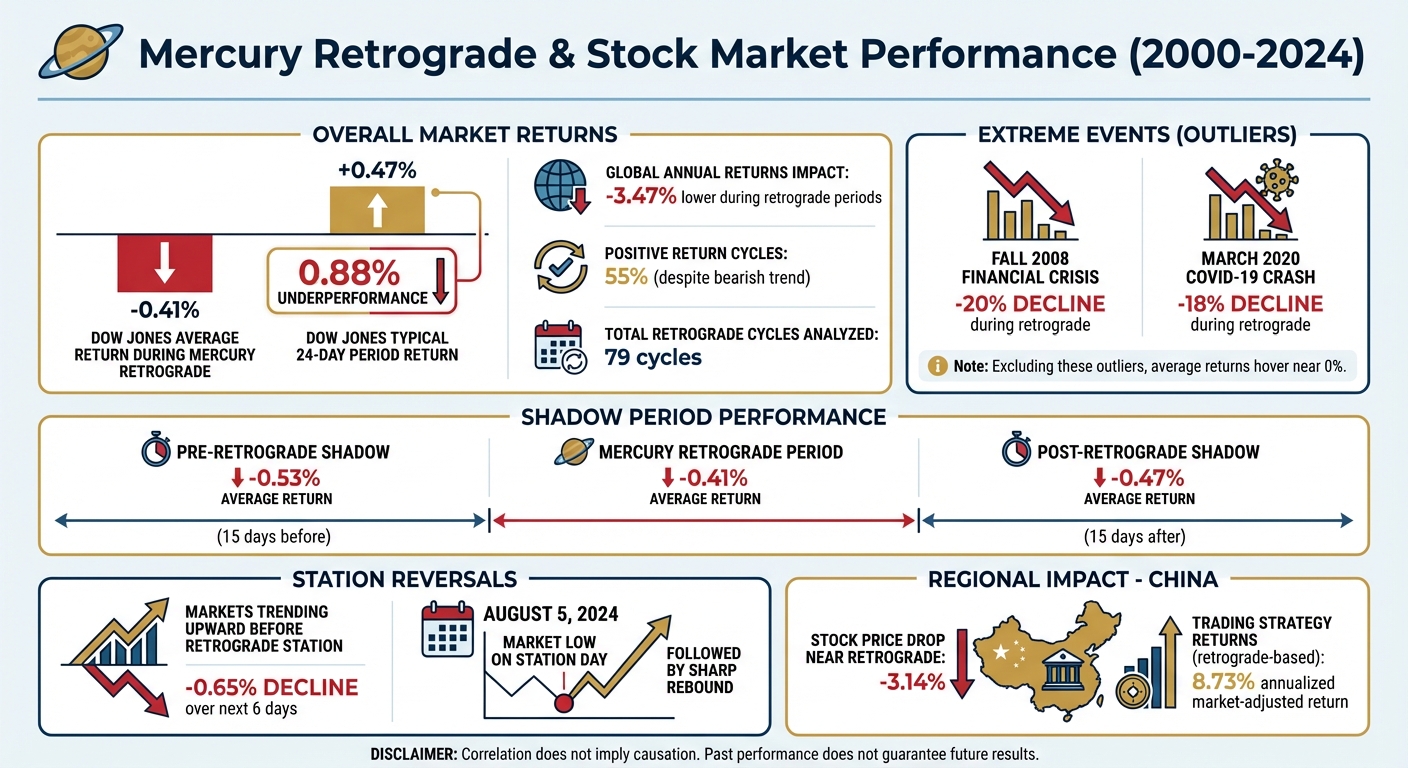
Mercury Retrograde Stock Market Performance: Historical Data 2000-2024
Historical data reveals a slight bearish trend during Mercury retrograde periods. Between 2000 and 2024, there were 79 Mercury retrograde cycles, during which the Dow Jones Industrial Average posted an average return of -0.41%. This contrasts with the typical +0.47% return for any comparable 24-day period. A broader study spanning 48 countries found that annual returns during Mercury retrograde were 3.47% lower on average. Interestingly, despite this bearish tendency, 55% of these cycles still delivered positive returns.
The more pronounced negative performance during these periods can largely be attributed to a few extreme events. For instance, during the fall 2008 financial crisis, the Dow plummeted by 20% within a Mercury retrograde cycle. Similarly, in March 2020, the COVID-19 market crash saw an 18% decline during a retrograde phase. Excluding these two outliers, the average return during Mercury retrograde cycles would hover closer to zero. This raises questions about whether these patterns are mere coincidence or if they reflect broader market dynamics. Let’s delve into how market volatility aligns with these astrological phases.
Market Volatility Patterns During Mercury Retrograde
Mercury's apparent shifts in motion often coincide with notable market movements. Specifically, when Mercury stations retrograde - appearing to pause before moving backward - markets frequently experience trend reversals. For example, when markets were trending upward before a retrograde station, they declined by an average of 0.65% over the following six days. A recent example occurred on August 5, 2024, when the market hit a short-term low on the very day Mercury stationed retrograde, only to rebound sharply during the remainder of the cycle. These reversals often set the tone for the broader market impact seen during the extended shadow periods.
Shadow periods, which occur roughly 15 days before and after Mercury retrograde, also show slight declines. On average, returns during the pre-retrograde shadow period dropped by -0.53%, while the post-retrograde shadow period saw declines of -0.47%. In markets like China, where astrological beliefs are more prominent, the impact appears even stronger. Studies show that Chinese stock prices dropped by 3.14% near Mercury retrogrades, and trading strategies based on these cycles achieved an average annualized market-adjusted return of 8.73%.
Understanding Correlation vs. Causation
Although there is a measurable correlation between Mercury retrograde and weaker market performance, causation remains unproven. Researchers propose a "culture-based investor belief channel", suggesting that investors who believe in astrological effects may become more cautious or pessimistic during these periods. This sentiment could influence trading behavior and, by extension, market outcomes.
That said, the extreme downturns during the 2008 and 2020 retrograde periods were driven by larger macroeconomic crises - the subprime mortgage collapse and the global pandemic, respectively. These events, while coinciding with Mercury retrograde, were the primary drivers of the dramatic declines observed. This highlights the importance of separating astrological patterns from broader financial realities when interpreting these trends.
How Astrology Affects Investor Decisions
The influence of Mercury retrograde on stock markets underscores the role of human psychology in financial decisions. Studies show that investors who believe astrological events impact market outcomes, often detailed in personalized astrology reports, often adopt a more pessimistic view of equities during retrograde periods. This shift in sentiment can lead to lower market confidence and reduced returns. This phenomenon, known as the "culture-based investor belief channel", suggests that ancient astrological traditions, like those from ancient Greece, still shape modern trading behaviors. The effect is most pronounced in markets sensitive to sentiment, particularly where asset values are subjective. For instance, technology stocks often experience more turbulence during Mercury retrograde, given the planet's traditional association with communication and technology. These psychological factors provide a lens through which we can understand investor behavior during these times.
Investor Mindset During Mercury Retrograde
Belief in Mercury retrograde's influence often leads traders to avoid signing new contracts, starting ventures, or entering the market during these periods. Aurora Murgea from the Faculty of Economics and Business Administration at West University of Timisoara explains:
"Mercury retrograde periods are characterized by confusion and miscommunications. The trades could be less effective, the individuals more prone to make mistakes so there is a long-held belief that it is better to avoid set plans."
During these times, many investors take a step back, using the opportunity to review past investments, correct financial planning errors, and double-check trading signals and broker communications. However, uncertainty can also lead to impulsive reactions to news, causing rapid price swings. A notable example occurred during the U.S. Presidential Election in November 2020, when Mercury retrograde (October 13 to November 3) coincided with heightened market volatility as investors reacted to fluctuating political and economic developments.
Interestingly, some research indicates that market volatility may actually decrease during Mercury retrograde. This could be due to the collective caution among investors, as many avoid taking new positions, which might inadvertently stabilize the market. These individual behaviors reflect broader cognitive biases, as discussed further below.
Behavioral Finance and Market Psychology
Behavioral finance sheds light on why investors often look for patterns in celestial events to explain market volatility or anomalies, even when such patterns might be purely coincidental. This tendency becomes more pronounced when asset valuations are uncertain, leaving investors more vulnerable to sentiment-driven influences.
In regions where astrological beliefs are more widespread, these effects are particularly noticeable. For example, studies show that Chinese stock prices have dropped by approximately 3.14% near Mercury retrograde periods, while trading strategies based on these cycles have delivered an average annualized market-adjusted return of 8.73%. Additionally, investors often turn to hedging strategies during retrograde periods, favoring put options over call options. This preference reflects a collective anxiety about potential communication failures, technical issues, or misinterpreted signals - factors that can heavily influence trading decisions and contribute to short-term price fluctuations.
How to Navigate Markets During Mercury Retrograde
Combining Astrology with Financial Strategy
Astrology can be a helpful supplement to your financial strategy, not a replacement. For instance, data indicates that stock market returns are 3.47% lower annually during Mercury retrograde periods. But this doesn’t mean you should completely revamp your portfolio every time Mercury appears to move backward. Instead, use astrological timing as an additional layer alongside your usual financial analysis.
One effective approach is to monitor the VIX (Volatility Index) during retrograde phases. Compare these readings with historical data from past retrograde cycles and pay attention to the shadow periods - the 14 days before and after the retrograde officially begins. These shadow periods often bring early or lingering volatility. To reduce risk, consider scaling back position sizes by 30–50% and wait for clear confirmations, like a full candle close or a retest of a support level, before making moves. These precautions can help you manage risk more effectively when the market feels unpredictable.
Historical patterns also highlight the importance of caution during these phases. While markets posted positive returns 55% of the time during Mercury retrograde periods from 2000 to 2024, the heightened uncertainty during these cycles makes careful position management essential.
Using Orbli for Real-Time Astrological Guidance

For those looking to integrate astrology into their financial strategies, tools like Orbli can offer practical, real-time insights. This platform provides detailed transit tracking and personalized guidance to help you navigate Mercury retrograde with more confidence.
With Orbli (https://orbli.app), you can track Mercury's position and upcoming retrograde cycles in real time. Its free calculators even allow you to explore your natal chart's Mercury placement, giving you a better understanding of how these periods might affect you personally. The Pro plan ($2 trial, then $4.99/week) includes daily and weekly forecasts that highlight key dates - like when Mercury goes retrograde or turns direct - and how these shifts could influence market trends.
Orbli’s timing predictions can help you schedule financial decisions more thoughtfully. For example, if you’re planning to sign a major contract, launch a new investment strategy, or rebalance your portfolio, the platform’s calendar can pinpoint better timing outside of retrograde windows. And when decisions can’t wait, Orbli’s daily guidance can remind you to double-check trading signals and broker communications before acting.
The platform also offers interactive courses to deepen your understanding of how Mercury retrograde interacts with other astrological factors. When paired with traditional financial tools - like monitoring interest rates, price-to-earnings ratios, or sector performance - this astrological insight becomes a useful addition to your decision-making process, rather than a source of unnecessary worry.
Conclusion
The connection between Mercury retrograde and stock market performance is anything but straightforward. Historical data reveals slightly weaker returns during these periods, though extreme events have skewed the averages. For instance, the Dow Jones Industrial Average logged an average return of –0.41% during 79 retrograde cycles from 2000 to 2024, compared to an expected 0.47% gain. However, it’s worth noting that positive returns still occurred in 55% of these instances.
It’s crucial to remember that correlation doesn’t imply causation. The psychological influence of Mercury retrograde - particularly through what’s called the "investor belief channel", where astrological beliefs create pessimism - has a measurable effect on markets sensitive to investor sentiment. For example, in the Chinese stock market, prices dropped by about 3.14% near retrograde periods, largely driven by superstitious behaviors among investors. This highlights how belief systems can intertwine with market behavior, emphasizing the need for both data-driven insights and strategic planning.
As Orgest, author of ValorAlgo, explains:
"The point is not to blindly believe in cosmic influence. The point is that the universe of potential data is larger than what is shown on a Bloomberg terminal."
– Orgest, Author, ValorAlgo
Astrological timing should be viewed as a supplementary tool, not a replacement for solid fundamental analysis. Key strategies include monitoring volatility indicators like the VIX and watching for trend reversals around retrograde and direct stations. Still, interest rates and broader economic fundamentals remain the dominant forces behind long-term market trends. Tools like Orbli’s real-time astrological insights (https://orbli.app) can complement traditional analysis, helping traders manage risk, validate signals, and adjust exposure during volatile times.
Navigating Mercury retrograde effectively requires blending hard data with an understanding of investor psychology. By balancing risk and reward, these cycles can become opportunities rather than obstacles. Using a mix of cosmic awareness and disciplined financial analysis allows traders to turn uncertainty into calculated decisions.
FAQs
Is this effect real or just coincidence?
Several studies have observed a link between Mercury retrograde and stock market behavior. Researchers have noted patterns such as lower returns and increased volatility during these periods. These findings suggest that the phenomenon might not be purely coincidental.
Do the shadow periods matter for trading?
Mercury retrograde shadow periods hold significance in trading. These phases can sway market sentiment, heighten volatility, and affect trend patterns. Traders often view retrograde cycles as timing indicators, helping them anticipate shifts in market behavior. As a result, these periods are closely monitored for their potential influence on trading strategies and overall market dynamics.
How should I adjust risk during Mercury retrograde?
During Mercury retrograde, it’s wise to approach investments with extra caution. Historically, this period has been linked to heightened market volatility and a tendency for impulsive decisions, which can increase financial risks. Prioritize thorough analysis and resist the urge to make quick financial moves to help you manage this phase more effectively.